



Michel Poivert
Professeur à l’Université Paris I Panthéon-Sorbonne, Michel Poivert dirige l’Unité de formation et de recherche Histoire de l’art et Archéologie. Président de la Société française de photographie membre de la rédaction de La Revue de l’Art et de la revue Études photographiques. Il a notamment publié Patrick Tosani (Flammarion, 2011), La photographie contemporaine (Flammarion en 2002 et 2010), L’image au service de la révolution (Le Point du Jour Éditeurs, 2006). Il a codirigé avec André Gunthert L’Art de la photographie, des origines à nos jours (Citadelles et Mazenod, 2007).

Macadam Color Street Photography
Jean-Christophe Béchet / Jean-Luc Monterosso / Sylvie Hugues / Michel Poivert
For several decades, Jean-Christophe Béchet has been pursuing a photographic career characterized by street photography, or what is known as street photo, a genre whose name has been perpetuated by the American photographic tradition.
In this new book, he revisits photographs taken throughout his career that particularly question the different situations of this type of photography. Through a hundred selected photographs and three interviews with image specialists, he seeks to question what this photography is, what it can bring into play, attempting to define some of its contours.
Macadam Color Street Photography
25.5 x 24.5 cm, 192 pages, 110 four-color reproductions, hardcover, cloth binding
ISBN: 978-2-843140-66-2
Graphic design: L’Atelier d’édition
Out of stock
ISBN: 978-2-843140-66-2
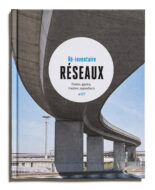
Réseaux
Philippe Ayrault / Stéphane Asseline / Laurent Kruszyk / Christian Décamps / Jean-Bernard Vialles / Paul Damm / Michel Poivert
Bridges, train stations, roads, aqueducts, and viaducts have been studied and photographed since the creation of the Île-de-France Inventory service. This new addition to the Ré-Inventaire collection offers a poetic journey through 40 years of photography.Without straying from the documentary style that is the hallmark of the Inventaire général's photographic work, the Inventaire's photographers drew inspiration from the work of photography's great masters, such as Lartigue and Rusha, to capture the experience of movement, speed, and the sheer scale of these infrastructures.Their work, presented in this book, reveals the raw beauty of these architectural structures.
Réseaux
6 x 20 cm, 72 pages, 50 color reproductions, hardcover
Co-published with the Île-de-France Region
ISBN: 978-2-843140-50-1
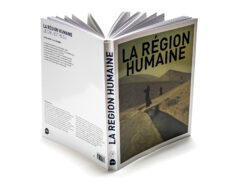
La région humaine
Michel Poivert / Gilles Verneret
For the 20th anniversary of the Lyon photography center, Le Bleu du Ciel, its director Gilles Verneret revisits the photographers who have exhibited there and, over time, defined a certain style of documentary photography. This book highlights the creativity and diversity of documentary photography through the works of nearly 100 photographers, many of whom are French, but also from around the world.
Since the 1990s and 2000s, the humanities and social sciences have become a new point of reference for photographers. By thwarting or sometimes openly criticizing the institution of photojournalism, photographers affirm the values of investigation, fieldwork, economic and social analysis, and political decryption. Our contemporaries are inventing a poetics of responsibility, turning documentary photography into a genre open to the imagination of a world to come.
In addition to historical texts by Gilles Verneret and Michel Poivert presenting different aspects of this new documentary photography, this book also includes texts written by the photographers featured.
La région humaine
24x 215;28 cm, 256 pages, 200 reproductions in four-color and black, paperback with flaps
Co-published with Le Bleu du Ciel
Graphic design: Larsquo; L’Atelier d’Édition
ISBN: 978-2-843140-35-8
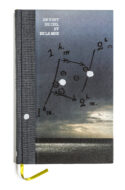
Du vent, du ciel et de la mer
Jacqueline Salmon / Michel Poivert
In 1785, Alexander Cozens published a method for imagining nature, not imitating it. He identified 23 skies, which Constable meticulously copied before reading Luke Howard's publication proposing a nomenclature for clouds and becoming fascinated by a "natural history of the heavens."
Jacqueline Salmon's Of Wind, Sky, and Sea can be seen as a revisited natural history, interwoven with art history and photographic creations.
Her research highlights the poetry that emerges from the porous boundary between art and science. It resonates with the collection of the Le Havre Museum, rich in works by Eugène Boudin, with meteorological codes, and with the light of the English Channel.
The book takes the form of a rich and varied collection, blending iconography from diverse sources, borrowed and selected by the artist, with her own creations. Michel Poivert delivers, as a counterpoint to this work, a text in the form of false notes, playing on his side with this scientific imagination characteristic of this book.
Du vent, du ciel et de la mer
18 x 29 cm, 208 pages, 355 four-color reproductions and 90 black and white reproductions, half-cloth cover
Graphic design: L’atelier d’édition
> in partnership with the Muma (Le Havre)
OUT OF STOCK
ISBN: 978-2919507-62-7
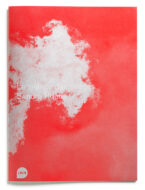
Le Silence des sirènes
Sandra Rocha / Michel Poivert
“Sandra Rocha’s book seems to breathe in this way; the defeat of seduction stems from a crisis of images, immediately conveyed by the artificial landscapes of wallpaper. Then opens the world after, a world of images that speak of desire without seducing. Women artists possess this genius for interiority, for the fundamental experience of feeling an inner body and being able to express this world. It will therefore be a question here of liquid, of floating, and of illusion; this book is a nocturnal bath from which resonates the stifled song of the sirens.” Michel Poivert
Le Silence des sirènes
24 x 32 cm, 64 pages, 37 full-color reproductions, paperback with Singer stitching, ISBN 9782919507559
By the same author: Immediate Life
Graphic design: Change is good
ISBN: 9782919507559
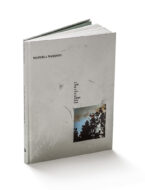
La taille de ce vent est un triangle dans l’eau
Manuela Marques / Michel Poivert / Sérgio Mah
The Size of This Wind Is a Triangle in the Water is a monograph that brings together Manuela Marques' recent work. The photographs in this book do not adhere to any thematic, chronological, or narrative order, but rather explore relationships, shifts, and juxtapositions between images. Through a wide range of subjects—trees, stones, hands, gestures—Manuela Marques seeks to question what we, as viewers, perceive of reality.
La taille de ce vent est un triangle dans l’eau
22 x 28 cm, 144 pages, 70 four-color reproductions, full-color hardcover with embossing, French / English
Graphic design: Frédéric Teschner
ISBN: 978-2-919507-24-5
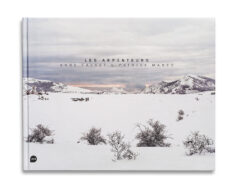
Les arpenteurs
Anne Favret / Patrick Manez / Michel Poivert
Depuis 1989, le paysage constitue un des éléments importants des préoccupations d'Anne Favret et Patrick Manez, le paysage comme la trace visible d’un monde en perpétuel renouvellement.
Cela faisait longtemps qu'ils cherchaient à travailler autour de l’idée d’utopie. La rencontre avec le plateau de Calern, paysage calcaire modelé de manière spectaculaire par les dolines sur lesquelles sont dispersées les différentes infrastructures de l’Observatoire astronomique, a permis de mettre en œuvre cette idée.
Ainsi, Anne Favret et Patrick Manez se sont immergés, semaine après semaine, dans la vie de l’observatoire, échangeant avec l’ensemble des équipes, accompagnant les événements du site, travaillant au rythme des saisons sur les différentes activités de Calern pour constituer un ensemble de prises de vues où se mêlent portraits, paysages, nature morte, photographies nocturnes.
Les arpenteurs
28 x 24 cm, 80 pages, 50 full-color reproductions, hardcover
Graphic design: Danish Pastry Design
ISBN: 978-2919507-28-3
La Montagne
Michel Poivert / Christophe Bourguedieu
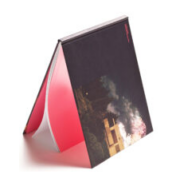
From the outset, the city's form is immediately apparent: the mountain of the title is indeed there, in the background, as are the forests, and streets, houses, a viaduct. Characters appear. Unusually for this author, they are active and captured in a particular moment of their lives, against the backdrop of poignantly ugly public facilities or the forests encircling the city. The arrangement of the photographs, in rhythmic "sentences," gradually reveals another interpretation of the narrative: from the opening, the street leading to the Michelin factory and its smoking chimneys under an orange sky appears as the stage for a provincial tragedy, the columns thus depicted foreshadowing the enchanted woods where a white dog keeps watch. Suppressed passions stir. A man fires a pistol, a young woman turns her head away, exhausted rugby players collapse on the field like defeated knights.
The Mountain shows us how Christophe Bourguedieu's universe adapts to describe our contemporaries, the mixing of times, the presence of "people", and engages without hesitation in a re-enchanted prosaicness.
“In the United States (Eden), Finland (Tavastia), and Australia (The Passengers), Christophe Bourguedieu has long worked to capture, through bodies, gazes, paths, and architecture, the feeling of a contemporary Western world. What the artist perceives is the reservoir of humanity. Places where a community maintains its democratic heritage in a transparent secrecy. For once in France, with La Montagne, he offers us a ballad—a genre usually reserved for music, but which I see as an equivalent here—a photographic ballad, therefore, to immerse ourselves in the space of the community.” (Excerpt from the text by Michel Poivert).
Entrusted to Guillaume Pavageau, the graphic designer of the James Gray book, the design of La Montagne plays on contrasts of materials and directly echoes the images by reconciling the mundane and the refined. Furthermore, the choice of a unique typeface, with its evocative name – Univers – also contributes to giving this publication a technical connotation, particularly suited to the artist's message.
La Montagne
28 x 23 cm landscape format, 64 pages, 26 four-color reproductions, full-color printed hardcover
Graphic design: Guillaume Pavageau
ISBN: 978-2-919507-08-5
La Dérivée mexicaine
Yves Trémorin / Michel Poivert
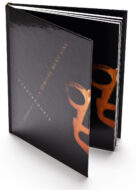
During a months-long artist residency in Mexico, Yves Trémorin set out to capture the essence of the country from a cultural, historical, and mythological perspective. Using his artistic skills, he returned from his Mexican journey with a fascinating collection of images, much like an ethnologist of a rather unique kind. His practice of capturing objects or portraits through photography, essentially building a collection to serve his chosen research, takes on its full meaning here. Isolating his subjects, often against a black background, as is his custom, he plays on the image of the Western explorer venturing into a distant land, bringing back, through his wanderings, objects and images that become like museum relics, essential for understanding a civilization with codes different from our own. The effect is all the more powerful because, in light of these photographs, a true portrait of Mexico emerges. This portrait is formed through the specificity of its inhabitants' bodies and the representations of symbolic figures found in images of animals or objects, which are then transposed into the realm of contemporary art. Nudes or portraits with unusual gestures seem to refer solely to the domain of performance art, while in fact they employ a sign language explicitly linked to representations buried in collective mythology. A breathtaking photograph of a black dog might refer to the figure of Ahuitzotl, a tattooed back to Quetzalcoatl—the famous feathered serpent—a toad photographed head-on at the back of a cave to the goddess Tlaltecuhtli, a stylized rabbit on an object of deliberate kitsch to the day of the rabbit Tochtli and her protector Mayahuel, goddess of the agave and fertility. Yves Trémorin's Mexican images avoid any photographic effect in order to focus on (and concentrate) the subject.
What is shown is never insignificant, never accidental: several layers of interpretation are to be discovered behind the apparent simplicity of the images, which might, at first glance, be considered a factual catalog of people, animals, or more or less exotic objects. Beyond references to a culture with ancient mythologies, to a people's particular relationship with death, and to wordplay, Trémorin's Mexican work does not forget that this country has been home to great artists. And through these images, we also find other mythologies, more photographic in nature, such as the masterpieces created by Edward Weston or Manuel Alvarez Bravo.
La Dérivée mexicaine
22 x 28 cm, 144 pages, hardcover, 80 four-color reproductions
ISBN: 978-2-919507-03-0