Jacqueline Salmon / Christine Bergé
In the history of French, European, and global nuclear power, Superphénix is a unique case. No other technological object, it seems, has unleashed so many contradictory passions, both technical and political.
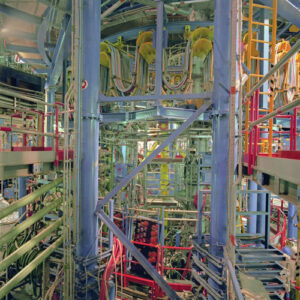
Since 1999, the Creys-Malville nuclear power plant has been undergoing decommissioning. In 2005, Jacqueline Salmon decided to undertake a major photographic project on nuclear waste. It was within this framework that she became interested in power plants undergoing decommissioning, and especially in Superphénix. She wanted to continue her exploration of places for which we bear a responsibility in the face of history. After obtaining the necessary permits, the photographer worked between 2007 and 2010 in areas not open to the public.
She brought back a remarkable collection of images that lend this personal work a documentary dimension, taking the curious reader behind the closed walls of the power plant. Today, in the control room, one notices many masked screens, now out of service. On the meter that once displayed the reactor’s power output, one reads “MHSD,” Permanently Decommissioned.
An accompanying text by anthropologist Christine Bergé focuses on accounts gathered from the plant’s employees, offering a unique perspective on this impressive nuclear reactor decommissioning project.
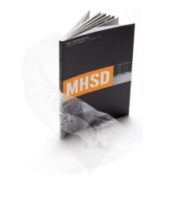
MHSD / Déconstruction, 22 x 28 cm, 96 pages, 50 full-color reproductions, paperback with flaps
Graphic design: Danish Pastry Design
« Soucieuse de constituer une mémoire des lieux emblématiques de la société contemporaine (les prisons de Clairvaux et de la Santé, le camp de Sangatte…), Jacqueline Salmon décide en 2005 de réaliser un important travail photographique sur les déchets nucléaires. C’est dans ce cadre qu’elle s’intéresse aux centrales en cours de déconstruction et surtout à Superphénix. Elle souhaitait y poursuivre son exploration des lieux dont on porte une responsabilité face à
l’histoire. »
« Jacqueline Salmon s’est demandée à quoi pouvait ressembler une centrale nucléaire en déconstruction. Après avoir obtenu les autorisations nécessaires, la photographe a travaillé sur les espaces non visibles au public. Elle a ramené un ensemble d’images remarquables qui donne à ce travail personnel une dimension documentaire qui fera passer le lecteur curieux de l’autre côté des enceintes fermées de la centrale. Aujourd’hui, dans la salle de commande, on remarque beaucoup d’écrans masqués, désormais hors d’usage. Sur le compteur qui affichait autrefois la puissance du réacteur, on lit “MHSD”, Mise Hors Service Définitive. »
Paris-Art